


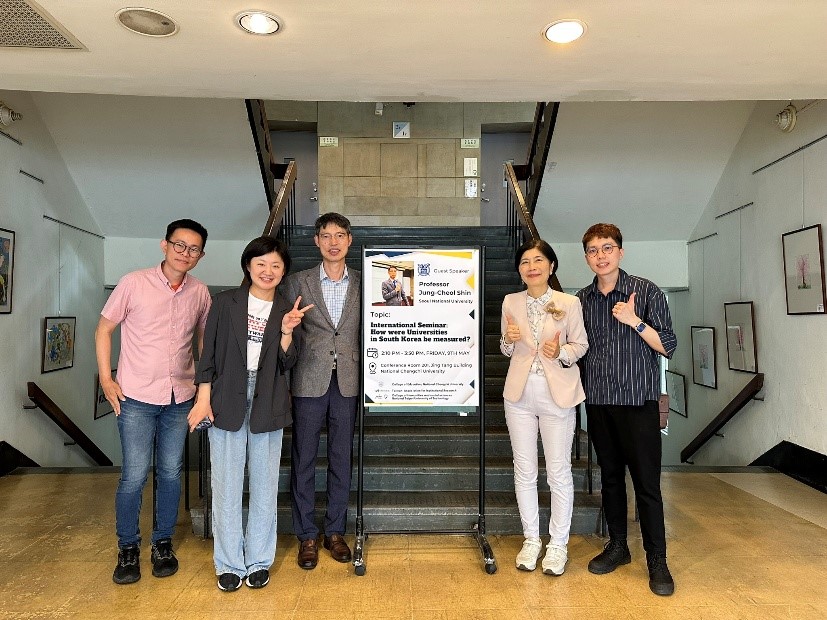


College of Education at National Chengchi University held an International Scholar Lecture for graduate students on May 9, 2025, featuring Professor Jung Cheol Shin from Seoul National University as the keynote speaker. The lecture, titled “Designing Performance Indicators for Higher Education,” explored the principles and global practices of evaluating university performance.
Professor Shin began by discussing the post-massification era of higher education, emphasizing that governments and universities worldwide are under increasing pressure to establish evaluation systems that ensure both educational quality and efficient resource allocation. Professor Shin noted that current evaluation methods primarily include quality assurance, accountability, and international rankings. However, frequent policy shifts and overly standardized indicators have led to a narrowing of institutional functions and increasing homogeneity among universities. Furthermore, conflicting indicator designs often undermine the distinct goals of each evaluation model. To address these challenges, Professor Shin proposed three core principles for designing effective performance indicators: first, they should guide long-term change and development, rather than merely focusing on short-term outcomes; second, they should serve as tools for institutional self-assessment and continuous improvement; third, they must align closely with each institution’s mission, characteristics, and strategic development goals to support sustainable advancement in higher education.
On a practical level, Professor Shin examined international experiences in higher education evaluation, particularly highlighting the UK's Research Excellence Framework (REF) and Teaching Excellence Framework (TEF). These systems assess universities across multiple dimensions, including research quality, social impact, and student learning outcomes, and are used to guide funding allocation and enhance institutional competitiveness. Moreover, Professor Shin further proposed a comprehensive indicator framework encompassing inputs, throughputs, outputs, and impacts, addressing both educational and research missions. Professor Shin emphasized that in a values-based higher education system—one that prioritizes character development, talent cultivation, and personal well-being—performance indicators must go beyond data and outputs to reflect broader social responsibilities and humanistic values. Key future metrics, he argued, should include student growth, civic engagement, and employment outcomes.
In conclusion, as higher education faces growing global competition and rising societal expectations, the design of institutionalized and evidence-based performance indicators has become central to reform efforts. Professor Shin’s insights and comparative international perspectives resonated strongly with graduate students from NCCU and National Taipei University of Technology. The engaging dialogue with an esteemed international scholar not only inspired critical reflections on the future of higher education assessment but also fostered inter-university collaboration and provided valuable guidance for the evolution of Taiwan’s evaluation systems.
